PHYSICS OF SEATBELTS VICTOR VIGODSKI
|
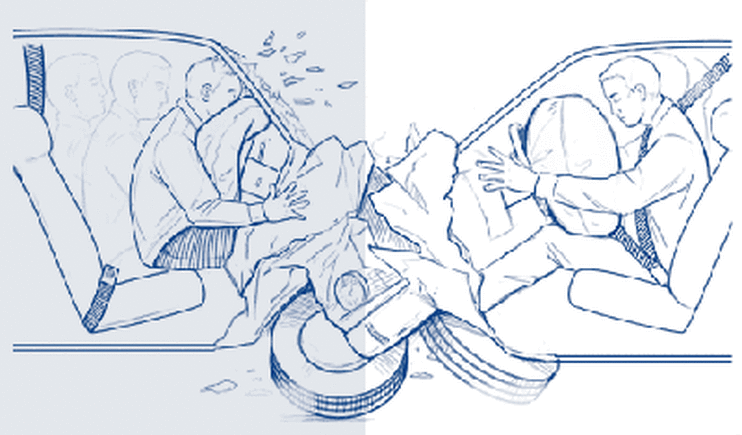
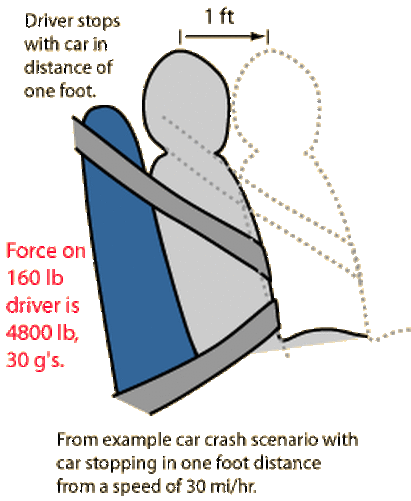
The task of the seatbelt is to stop you with the car so that your stopping distance is probably 4 or 5 times greater than if you had no seatbelt. A crash which stops the car and driver must take away all its kinetic energy, and the work-energy principle then dictates that a longer stopping distance decreases the impact force. For the example car crash scenario the stopping distance is one foot, the force on a 160 lb driver is about 4800 lb or 2.4 tons, and the deceleration about 30 g's. A moderate amount of stretch in the seatbelts will reduce the average impact force.
|
|
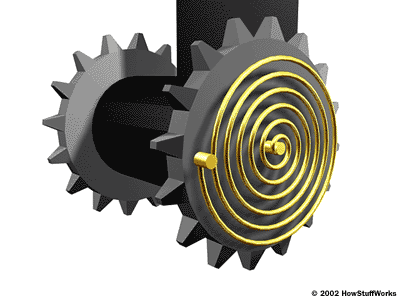
In a typical seatbelt system, the belt webbing is connected to a retractor mechanism. The central element in the retractor is a spool, which is attached to one end of the webbing. Inside the retractor, a spring applies a rotation force, or torque, to the spool. This works to rotate the spool so it winds up any loose webbing.
When you pull the webbing out, the spool rotates counter-clockwise, which turns the attached spring in the same direction. Effectively, the rotating spool works to untwist the spring. The spring wants to return to its original shape, so it resists this twisting motion. If you release the webbing, the spring will tighten up, rotating the spool clockwise until there is no more slack in the belt. |
|
